Xiamen Tmax Battery Equipments Limited was set up as a manufacturer in 1995, dealing with lithium battery equipments, technology, etc. We have total manufacturing facilities of around 200000 square foot and more than 230 staff. Owning a group of experie-nced engineers and staffs, we can bring you not only reliable products and technology, but also excellent services and real value you will expect and enjoy.
Solid State Battery Fabrication Line: Overview, Features, Process, Applications, Advantages, and Conclusion
Overview
A Solid State Battery Fabrication Line is an advanced, integrated system of mechanical and process equipment designed for the precise production of solid-state batteries (SSBs). Unlike conventional lithium-ion battery manufacturing lines that rely on liquid electrolytes, fabrication lines for solid-state batteries focus on handling solid electrolytes and multilayer architectures with stringent requirements for uniformity, density, and interface quality. These fabrication lines are engineered to support various solid electrolyte chemistries, including sulfide-, oxide-, and polymer-based systems, and are critical for enabling the commercialization of next-generation energy storage technologies. By combining precision engineering, automation, and controlled environments, solid state battery fabrication lines ensure high-quality and reproducible battery cell production.
Features
Solid state battery fabrication lines are characterized by a set of advanced features tailored to the complexity of solid-state systems:
1. High-Precision Layer Control: Equipment within the line enables micron-level thickness control for electrodes and solid electrolyte layers, ensuring optimal electrochemical performance.
2. Integrated Automation and Control: Automated handling, alignment, and processing systems reduce variability and enhance reproducibility across production batches.
3. Atmosphere Control Systems: Fabrication processes often occur in dry rooms or inert gas environments to protect moisture-sensitive materials, particularly sulfide-based electrolytes.
4. Compatibility with Multiple Processing Routes: The line can support slurry-based coating, dry processing, and thin-film deposition techniques depending on cell design.
5. Advanced Interface Engineering Capability: Specialized pressing and sintering equipment improve interfacial contact between layers, a critical factor in solid-state battery performance.
Process
The fabrication process within a solid state battery fabrication line involves several key stages, each requiring specialized machinery and precise control:
1. Raw Material Preparation: Cathode, anode, and solid electrolyte materials are synthesized and processed into powders or slurries. Mixing equipment ensures homogeneous distribution of active materials and additives.
2. Coating or Film Formation: Thin films of electrode and electrolyte materials are produced using techniques such as tape casting, slot-die coating, or vapor deposition. The choice of method depends on the desired battery architecture.
3. Drying and Solvent Removal: Coated layers are subjected to controlled drying processes to remove solvents without introducing defects such as cracks or voids.
4. Densification and Calendaring: Mechanical pressing or calendaring improves layer density and enhances contact between particles, which is essential for ionic conductivity and mechanical stability.
5. Layer Stacking and Alignment: Multiple functional layers are precisely aligned and stacked using automated systems. Accurate positioning ensures consistent performance across cells.
6. Lamination and Sintering: Layers are bonded through lamination or sintering processes, creating a cohesive structure with strong interfacial adhesion.
7. Cell Assembly and Packaging: The multilayer structure is integrated with current collectors, sealed, and packaged into final cell formats such as pouch, cylindrical, or prismatic cells.
8. Formation and Testing: Fabricated cells undergo electrochemical formation cycles and quality testing to evaluate capacity, efficiency, and safety.
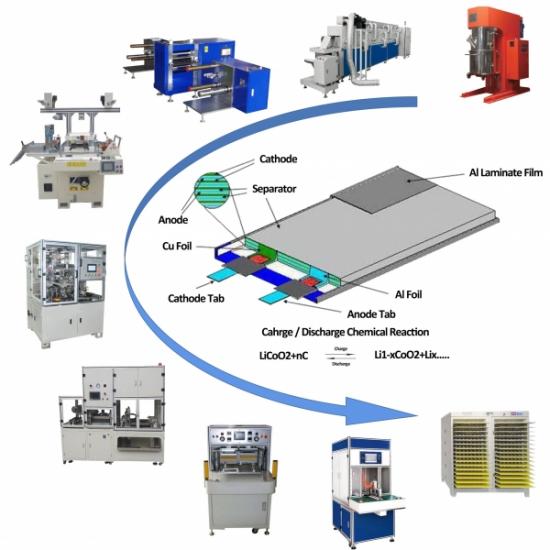
Pouch Cell Production Equipment
Applications
Solid state battery fabrication lines enable the production of batteries for a wide range of high-performance applications:
1. Electric Vehicles (EVs): Fabrication lines support the development of batteries with higher energy density and enhanced safety, critical for next-generation EVs.
2. Consumer Electronics: Compact and efficient batteries produced on these lines are used in smartphones, laptops, and wearable devices.
3. Grid Energy Storage: Solid-state batteries offer long cycle life and stability, making them suitable for renewable energy storage systems.
4. Aerospace and Defense: Applications requiring high reliability and resistance to extreme conditions benefit from solid-state battery technology.
5. Medical Devices: Implantable and portable medical devices utilize solid-state batteries for their safety and longevity.
Advantages
Solid state battery fabrication lines offer several advantages over traditional battery manufacturing systems:
1. Enhanced Safety: The elimination of flammable liquid electrolytes significantly reduces the risk of leakage, fire, and thermal runaway.
2. Higher Energy Density: Precise fabrication enables thinner layers and improved material utilization, leading to increased energy storage capacity.
3. Improved Cycle Life: Stronger interfaces and stable materials result in longer battery lifespans.
4. Reduced Defects: Advanced process control and automation minimize defects such as delamination, void formation, and contamination.
5. Process Versatility: The ability to handle multiple materials and fabrication techniques makes these lines adaptable to evolving technologies.
6. Scalability and Reproducibility: Fabrication lines are designed for consistent output and can be scaled from pilot to industrial production.
Conclusion
The Solid State Battery Fabrication Line represents a cornerstone in the transition toward next-generation energy storage solutions. By integrating high-precision equipment, advanced process control, and flexible manufacturing capabilities, these lines address the complex requirements of solid-state battery production. Their ability to produce high-quality, safe, and high-performance batteries positions them as a critical enabler for industries ranging from electric vehicles to renewable energy systems. As research and development continue to advance solid-state battery materials and designs, fabrication lines will evolve to incorporate new technologies, further improving efficiency and scalability. Ultimately, solid state battery fabrication lines will play a pivotal role in driving the widespread adoption of safer and more efficient energy storage systems worldwide.



 ko
ko en
en fr
fr de
de ru
ru es
es pt
pt tr
tr pl
pl th
th
 IPv6 네트워크 지원


