Xiamen Tmax Battery Equipments Limited was set up as a manufacturer in 1995, dealing with lithium battery equipments, technology, etc. We have total manufacturing facilities of around 200000 square foot and more than 230 staff. Owning a group of experie-nced engineers and staffs, we can bring you not only reliable products and technology, but also excellent services and real value you will expect and enjoy.
Lithium battery pack machinery encompasses a range of specialized equipment designed to automate and streamline the production process of lithiumion or lithium ferro phosphate (LiFePO4) battery packs. These machines are critical for ensuring highquality, safe, and efficient assembly of battery packs used in electric vehicles (EVs), portable electronics, energy storage systems, and more. Here’s an overview of the types of machinery you might find in a lithium battery pack production line:
Key Machinery in Lithium Battery Pack Production
1. Cell Sorting and Inspection Machines
Purpose: To inspect and sort cells based on capacity, internal resistance, voltage, and other key parameters.
Functionality: Automated testers evaluate each cell's performance and categorize them accordingly. This ensures uniformity within battery packs.
2. Welding Machines
Types: Ultrasonic welding, laser welding, and resistance welding machines.
Purpose: Used to connect battery cells with busbars or other connectors, forming series and parallel connections.
Advantages: Provides strong, lowresistance joints essential for reliable battery operation.
3. Module Assembly Machines
Purpose: Automates the grouping of cells into modules.
Features: Includes positioning, connecting, and sometimes encapsulating cells within a module frame. May also integrate cooling mechanisms like liquid cooling plates or air channels.
4. Battery Management System (BMS) Integration Equipment
Purpose: Installs and integrates BMS components into the battery pack.
Functionality: Involves placing sensors, control units, and wiring harnesses, by programming and calibration of the BMS.
5. Pack Enclosure Machines
Purpose: Assembles the final battery pack by housing modules within protective enclosures.
Features: Can include sealing, riveting, or screwing processes to ensure robust protection against environmental factors.
6. Thermal Management System Installation Machines
Purpose: Integrates thermal management solutions to maintain optimal operating temperatures.
Features: Might involve installing cooling plates, fans, or heat sinks, and connecting them to the battery modules.
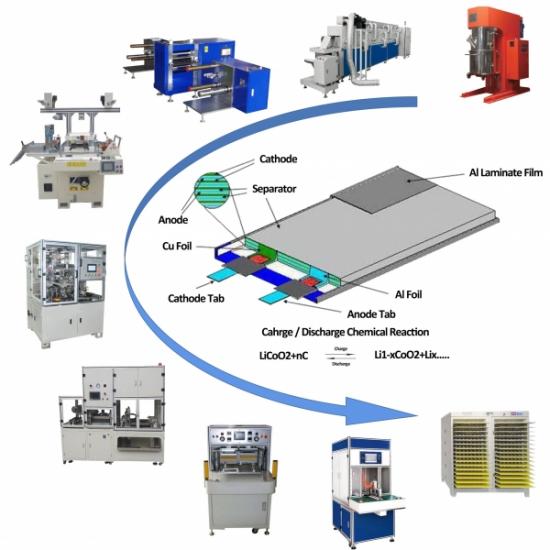
Pouch Cell Pilot Line
7. Testing and Calibration Stations
Types: Chargedischarge testers, insulation resistance testers, and functional verification stations.
Purpose: Conduct rigorous tests to verify the performance and safety of the assembled battery packs.
Functionality: Ensures that each battery pack meets specified electrical and safety standards before leaving the factory.
8. Quality Assurance and Final Inspection Systems
Types: Machine vision systems, automated inspection robots.
Purpose: Perform detailed visual inspections and detect defects such as misalignments, surface imperfections, or faulty welds.
Features: Provide documentation and serialization for traceability throughout the manufacturing process.
9. Labeling and Packaging Machines
Purpose: Apply labels containing essential information and package the finished battery packs securely.
Features: Labeling machines print and apply labels automatically, while packaging systems ensure safe transport through customdesigned packaging solutions.
Advanced Technologies
Automation and Robotics: AGVs and robotic arms handle material handling, precision tasks, and complex assemblies, enhancing efficiency and reducing human error.
Data Analytics and AI: Monitor production lines for realtime adjustments, predict maintenance needs, and optimize the overall assembly process.
By incorporating these advanced machines and technologies, lithium battery pack production lines can achieve high levels of productivity, quality, and safety. This not only ensures the production of reliable and durable battery packs but also supports the growing demand for highperformance batteries across various industries.



 ko
ko en
en fr
fr de
de ru
ru es
es pt
pt tr
tr pl
pl th
th
 IPv6 네트워크 지원


